
Functional Movement Systems
More Thorough Evaluations. More Informed Treatments.
Comprehensive movement assessments that take the guesswork out of rehabilitation. From Pain to Performance.
At Savvy Physical Therapy, we believe that understanding how your body moves is just as important as understanding where it hurts.
Pain, injury, stiffness, weakness, and recurring injuries can be influenced by how different parts of your body work together. Simply treating the area that hurts may overlook other factors contributing to your symptoms.
That's why we utilize Functional Movement Systems (FMS), a comprehensive, systematic approach to evaluating movement, identifying physical limitations, guiding rehabilitation, and improving physical performance.
Whether you are experiencing pain, recovering from surgery, looking to prevent injuries, striving to improve athletic performance, or wondering if you’re really ready to return to sport, our evaluation system allows us to meet you wherever you are and help you progress toward your individual goals.
Dr. Ryan Smith is Denver's first Functional Movement Systems Fellow, a distinction reflecting advanced education and expertise in comprehensive movement assessment, clinical decision-making, and corrective exercise.
We don't just evaluate your injury.
We evaluate how your whole body moves.
What Is Functional Movement Systems?
Functional Movement Systems is a collection of standardized movement assessments and physical performance tests designed to help us understand how your body moves and functions.
Rather than evaluating individual muscles and joints in isolation, the system examines how mobility, stability, strength, balance, and motor control work together to produce movement.
The system provides us with a structured and repeatable approach to:
Identify movement limitations and asymmetries.
Investigate factors contributing to pain and injury.
Differentiate mobility restrictions from stability/motor control limitations.
Establish an objective baseline of physical function.
Develop individualized treatment and corrective exercise programs.
Measure progress throughout rehabilitation.
Assess readiness to return to exercise and sports.
Identify physical limitations that may benefit from preventive care.
By utilizing a consistent evaluation system, we can make more informed clinical decisions rather than relying solely on symptoms, isolated strength measurements, or subjective observations.
The Four Components of Our Functional Movement Approach
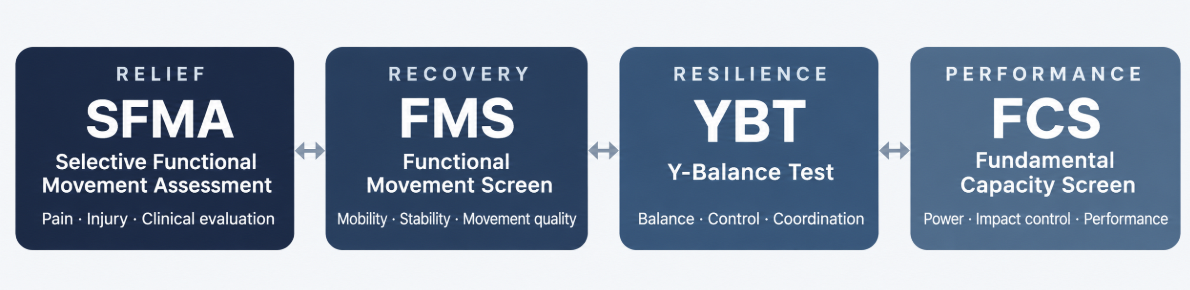
Functional Movement Systems provides several complementary assessment tools. Each serves a different purpose depending on your symptoms, physical abilities, and goals.
1 - Selective Functional Movement Assessment (SFMA)
For individuals experiencing pain, injury, or movement-related symptoms.
The Selective Functional Movement Assessment is a comprehensive clinical movement assessment designed for healthcare professionals evaluating individuals with pain.
When limitations are identified, we systematically break down those movements to investigate whether they are related to mobility restrictions, stability limitations, or difficulties with motor control.
This approach allows us to look beyond the location of your symptoms and investigate other physical limitations that may be contributing to your condition.
The SFMA helps guide our treatment decisions for individuals experiencing:
Back and neck pain
Shoulder, hip, knee, and ankle pain
Sports-related injuries
Chronic and recurring pain
Restricted mobility
Post-surgical movement limitations
Difficulty returning to normal activities
As treatment progresses, we can repeat portions of the assessment to determine how your movement is responding and adjust your rehabilitation accordingly.
2 - Functional Movement Screen (FMS)
For individuals looking to improve movement quality, establish a baseline, and reduce injury risk factors.
The Functional Movement Screen evaluates seven fundamental movement patterns that require varying combinations of mobility, stability, coordination, and motor control.
Each movement is scored using standardized criteria to identify movement limitations and differences between the right and left sides of the body.
The Functional Movement Screen is particularly useful for individuals who are not currently experiencing pain but want to improve how they move, identify physical limitations, or prepare for increased physical activity.
It can also be used as a progression from injury rehabilitation, helping us evaluate movement quality before introducing more demanding exercises and activities.
The results allow us to develop targeted corrective exercise programs and establish a measurable baseline for future reassessment.
3 - Y-Balance Test (YBT)
For individuals looking to improve dynamic balance, stability, motor control, functional symmetry, and test for readiness to return to their activities while reducing risk of re-injury
The Y-Balance Test is a standardized assessment that challenges your ability to maintain balance and control while reaching in multiple directions.
Both upper-body and lower-body versions of the test are available, allowing us to evaluate different aspects of functional stability and motor control.
The Y-Balance Test provides objective measurements that can help us identify:
Differences between the right and left sides of the body.
Limitations in dynamic balance.
Reduced single-leg stability.
Upper-body stability and control limitations.
Functional deficits following injury or surgery.
Areas that may require additional rehabilitation before returning to sport.
Unlike simply standing on one leg, the Y-Balance Test challenges your ability to maintain control while your body is moving.
4 - Fundamental Capacity Screen (FCS)
For individuals looking to bridge the gap between movement quality and physical performance.
Moving well is an important foundation, but your body also needs the physical capacity to tolerate the demands of your lifestyle, occupation, exercise routine, or sport.
The Fundamental Capacity Screen evaluates how effectively your body produces, transfers, controls, and absorbs force during more physically demanding activities.
The FCS examines four fundamental areas:
Movement Control: Your ability to maintain control during dynamic movement.
Postural Control: Your ability to maintain alignment and stability while carrying a load.
Explosive Control: Your ability to generate power through coordinated movement.
Impact Control: Your ability to absorb and redirect forces during dynamic activities.
This assessment helps us identify physical capacity limitations that may not be apparent during a traditional movement screen.
It can be particularly valuable for athletes, runners, weightlifters, recreational sports participants, and individuals preparing to return to physically demanding activities following an injury.
A Dynamic System That Adapts to You
One of the greatest advantages of Functional Movement Systems is that it is not a rigid, linear rehabilitation program.
Your body changes from day to day. Pain, fatigue, physical activity, recovery, new injuries, and training demands can all influence how you move and perform.
Your physical therapy program should be able to adapt to those changes.
At Savvy Physical Therapy, we can progress or modify your evaluation and treatment depending on how you present at each appointment.
If you are experiencing pain, we may utilize the Selective Functional Movement Assessment to investigate your symptoms and identify relevant movement limitations.
As your pain improves, we can transition toward evaluating fundamental movement quality, dynamic balance, stability, and physical capacity.
If you develop new symptoms or experience a flare-up, we can return to a more detailed clinical assessment, address those limitations, and modify your rehabilitation program accordingly.
This does not mean you are starting over. It means your care is adapting to what your body needs at that particular time.
You don't have to fit into our rehabilitation program.
Our rehabilitation program adapts to you and your goals.
More Than a Medical Diagnosis
A medical diagnosis helps identify what structure or condition may be responsible for your symptoms. A movement diagnosis helps us understand how your body is functioning and what physical limitations may be contributing to those symptoms.
For example, two individuals with the same diagnosis of knee pain may have completely different movement limitations.
One individual may have restricted ankle mobility, while another may have difficulty controlling their hip and pelvis during single-leg activities.
Although their medical diagnoses may be similar, their rehabilitation programs may need to be very different.
At Savvy Physical Therapy, we combine traditional orthopedic examination techniques with comprehensive, full-body movement assessments to develop a more complete understanding of your condition.
This allows us to individualize your treatment rather than providing a generic rehabilitation program based solely on your diagnosis.
From Pain Relief to Physical Performance
Traditional physical therapy often ends when pain resolves or basic functional goals have been achieved.
However, being pain-free does not necessarily mean that you have restored your previous strength, mobility, balance, coordination, or physical capacity.
At Savvy Physical Therapy, we believe that pain relief can be the beginning of your rehabilitation journey rather than the end.
Our movement-based approach allows you to continue progressing through different stages of physical health.
Relief
Reduce pain, investigate symptoms, restore mobility, and address physical limitations that may be contributing to your condition.
Recovery
Restore fundamental movement patterns, muscle activation, stability, motor control, and strength.
Resilience
Develop the balance, strength, coordination, and physical capacity necessary to tolerate the demands of everyday life, exercise, work, and sports.
Performance
Build upon your movement foundation to improve athletic performance, prepare for demanding physical activities, and work toward your individual fitness goals.
You can enter this system at any point. You do not need to be injured to benefit from a movement assessment, and you do not need to stop physical therapy simply because your pain has resolved.
How far you progress along this spectrum depends on your individual needs and goals.
How We Use Movement Assessments to Guide Treatment
A comprehensive movement assessment is only valuable if the information gathered leads to meaningful treatment decisions.
At Savvy Physical Therapy, your assessment findings help determine which treatment techniques and exercises are most appropriate for you.
Your individualized treatment program may include:
Manual therapy
Corrective exercises
Neuromuscular re-education
Neubie by NeuFit electrical stimulation
Shockwave therapy
Dry needling
Blood flow restriction training
Progressive strengthening
Balance and coordination training
Functional and sport-specific rehabilitation
Rather than using the same treatment approach for every patient, we select the tools that best address your individual physical limitations.
We then reassess your movement to evaluate your response and guide the next steps in your rehabilitation.
This ongoing process of assessment, treatment, and reassessment is fundamental to our approach.
You Don't Have to Be Injured to See a Physical Therapist
Many people wait until they experience pain or sustain an injury before seeking physical therapy.
However, movement assessments can also provide valuable information when you are feeling healthy and functioning well.
Establishing a baseline of your movement quality, balance, strength, and physical capacity can help you better understand your body and identify areas that may benefit from additional attention.
Just as you schedule routine medical, dental, and vision examinations, a periodic movement assessment can be a valuable component of maintaining your physical health.
Whether you are preparing for ski season, starting a new exercise program, training for a race, returning to the gym, or simply looking to remain active as you age, our movement assessments can help guide your physical development.
Our goal is not to find problems for the sake of finding problems. It is to help you make informed decisions about your movement, exercise, and long-term physical health.
A More Comprehensive Approach to Return-to-Sport Testing
Returning to sport requires more than allowing sufficient time for an injury to heal.
An individual may no longer experience pain but still demonstrate limitations in strength, mobility, balance, motor control, power, or the ability to absorb impact.
By combining Functional Movement Systems assessments with objective strength measurements and sport-specific testing, we can develop a more comprehensive understanding of your readiness to return to physical activity.
This information helps us identify remaining rehabilitation needs and guide a progressive return to the activities you enjoy.
No single movement screen or performance test can guarantee an injury-free return to sport. However, a comprehensive assessment can help you and your physical therapist make more informed decisions throughout the process.
Measure Your Progress. Don't Just Guess.
One of the most important benefits of a standardized evaluation system is the ability to objectively measure changes over time.
Rather than relying solely on how you feel, we can reassess your movement patterns, balance, physical capacity, and other measurable aspects of your function.
This helps us answer important questions:
Has your mobility improved?
Are you moving with better control?
Have meaningful differences between sides improved?
Are you tolerating greater physical demands?
Are your exercises addressing your individual limitations?
What should we focus on next?
By combining your personal experience with objective assessment findings, we can continually refine your treatment program and help you work toward meaningful, measurable goals.
Comprehensive Movement Assessments in Denver, Colorado
At Savvy Physical Therapy, our approach to physical therapy extends beyond treating injuries and managing pain.
We provide personalized, one-on-one care using comprehensive movement assessments, innovative treatment technologies, and individualized corrective exercise programs to help you improve your physical health.
Whether you are currently experiencing pain or simply want to better understand how your body moves, we can help you identify an appropriate starting point and develop a plan to move forward.
Proudly recognized as Westword's Best Physical Therapy in Denver in 2024 and 2025, Savvy Physical Therapy is committed to helping you move better, feel better, and remain active throughout your life.